



What the USPTO SMED guidance means for inventors
Your invention solves a technical problem. Your patent application needs to explain that contribution clearly, and the evidence supporting it can matter when patent eligibility is questioned.
On September 29, 2026, the United States Patent and Trademark Office published a memorandum and an accompanying flowchart on Subject Matter Eligibility Declarations, known as SMEDs. These are optional declarations that applicants can use to clarify the record or help overcome an objection that an invention does not qualify for patent protection under Section 101.
For inventors, the guidance offers a practical reason to think about technical evidence early, and It supplements existing guidance.
Why the technical explanation matters
An eligibility objection can raise questions about whether the claims describe eligible subject matter. The claims are the specific features for which patent protection is sought. The memorandum discusses developments involving software and machine learning, as well as medical diagnostics.
One example it highlights is a machine learning method addressing “catastrophic forgetting,” which it describes as a concrete technical improvement to how computers function. The useful lesson for inventors is to make the particular technological improvement understandable and show how the claims reflect it.
A SMED provides an opportunity to support that explanation with objective evidence. The examiner considers the declaration together with the other evidence in the application record.
What makes a declaration persuasive
The accompanying flowchart asks whether the declaration presents objective evidence and whether there is a sufficient factual and legal connection between that evidence and the claims.
This connection deserves attention. Evidence about a technology generally needs to explain something relevant to the particular invention being claimed. The memorandum gives the example of a trade article describing technological limitations known when the application was filed. Such material could support an expert’s explanation that a skilled person would have recognized the technological improvement disclosed in the application and reflected in the claims.
The guidance also encourages applicants to identify the precise eligibility issue the declaration addresses. A focused explanation helps the examiner understand what the evidence is intended to establish.
Plan the evidence early
The USPTO recommends considering a SMED as early as possible, potentially before the examiner’s first substantive review. Later submissions can face procedural restrictions, especially after prosecution has closed.
For inventors, this suggests discussing possible eligibility issues with the patent attorney while the technical explanation and supporting material are being prepared. The memorandum also encourages submitting a separate declaration devoted to eligibility, even though a declaration addressing several grounds of rejection is permitted.
Choose the right person to explain the facts
A declaration must be signed by someone who knows the facts being asserted. When assessing an expert opinion, the examiner considers its factual support, any opposing evidence and the expert’s interest in the outcome.
An inventor’s declaration cannot be disregarded simply because the inventor has an interest in the application. However, the guidance explains that a declaration from a disinterested person may be more persuasive. Independent expertise can therefore be worth considering when it helps establish the relevant technical facts.
Keep the original application complete
A later declaration cannot replace information that needed to appear in the original disclosure. The flowchart specifically asks whether the evidence is supplying such information when assessing its weight.
That is a reason to give the original technical description careful attention. The application should explain the improvement for which protection is sought; a declaration can support the examiner’s understanding of that disclosure.
How to read the USPTO flowchart
The original two-part flowchart follows this article. Part 1 covers timing, required statements and signature. Part 2 addresses objective evidence, its connection to the claims and its relationship to the original disclosure, before the examiner weighs all the evidence.
The chart states that eligibility is assessed using the preponderance of the evidence standard: a rejection is proper only when the claims are more likely than not to be ineligible. An even balance should favor the applicant on that question. This concerns eligibility, rather than automatic patent approval.
The memorandum also encourages interviews with examiners to improve understanding of specific eligibility issues. For an inventor preparing a US application, a useful starting point is to ask: have we explained the technical contribution clearly, and what evidence would help the examiner assess it?
Sources: USPTO memorandum dated September 29, 2026, Subject Matter Eligibility Declarations under 37 CFR 1.132 — Flowchart for Analysis and Best Practices; accompanying SMED flowchart.
USPTO flowchart Formality review
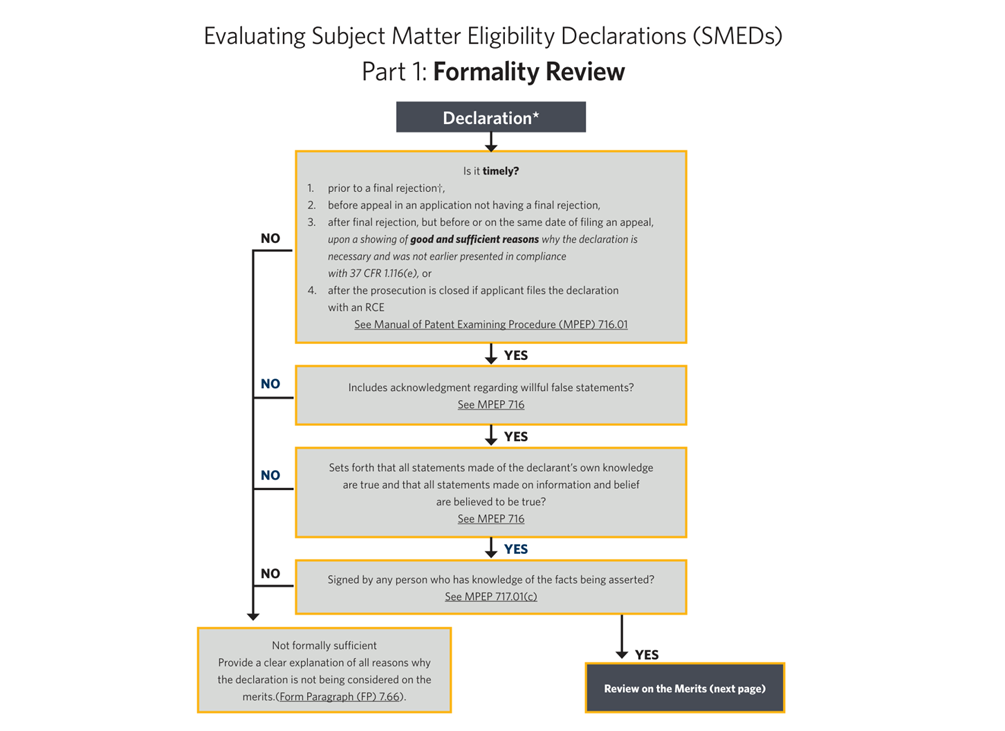
Source: USPTO accompanying SMED flowchart. Original reproduced without modification.
USPTO flowchart Review on the merits
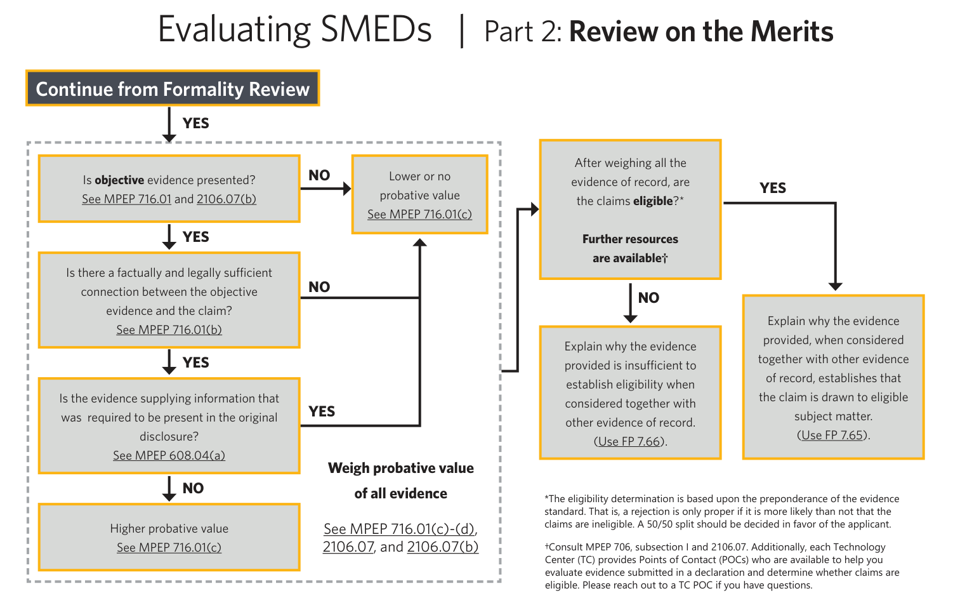
Source: USPTO accompanying SMED flowchart. Original reproduced without modification.